Introduction
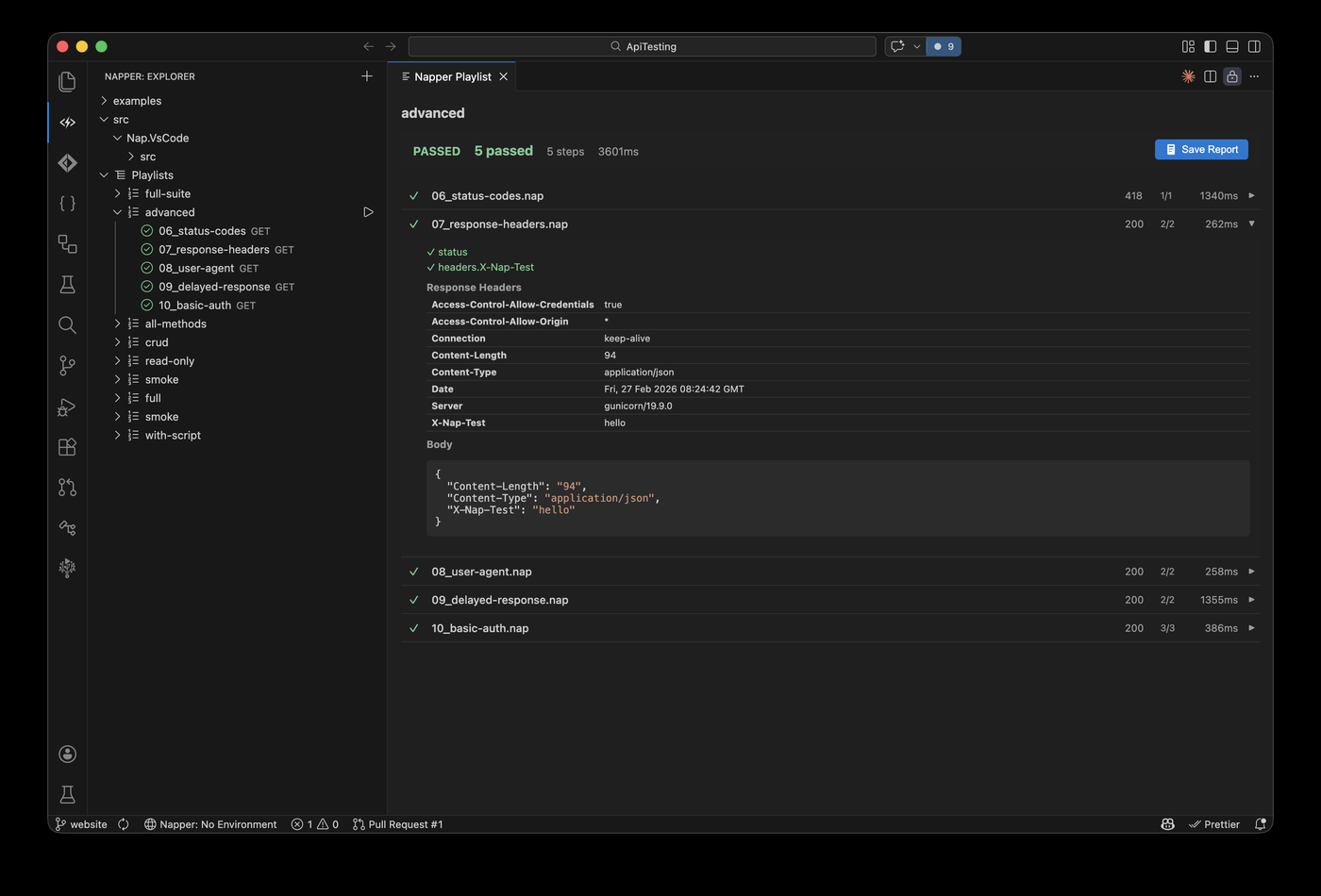
Napper is a free, open-source, CLI-first API testing tool for anyone testing APIs. It integrates natively with VS Code and Zed, and works in any editor through a portable language server. It is a modern alternative to Postman, Bruno, .http files, and curl.
Napper is built for anyone who wants:
- Simple things to be simple — a one-off request is nearly as terse as curl (spec: nap-minimal)
- Complex things to be possible — script advanced flows in JavaScript, Python, F#, or C# (spec: script-js, script-py, script-fsx, script-csx)
- Everything in version control — plain text files, no binary blobs (spec: nap-file, naplist-file, env-file)
- First-class editor support — VS Code, Cursor, Windsurf, Antigravity, and Zed extensions plus a portable LSP: syntax highlighting, Test Explorer, environment switching
- No runtime to install — Napper ships as a self-contained native binary, not a .NET DLL
- Easy migration — convert existing
.httpfiles with a single CLI command (spec: cli-convert)
How does Napper work?
Every HTTP request is a .nap file (spec: nap-file):
GET https://api.example.com/health
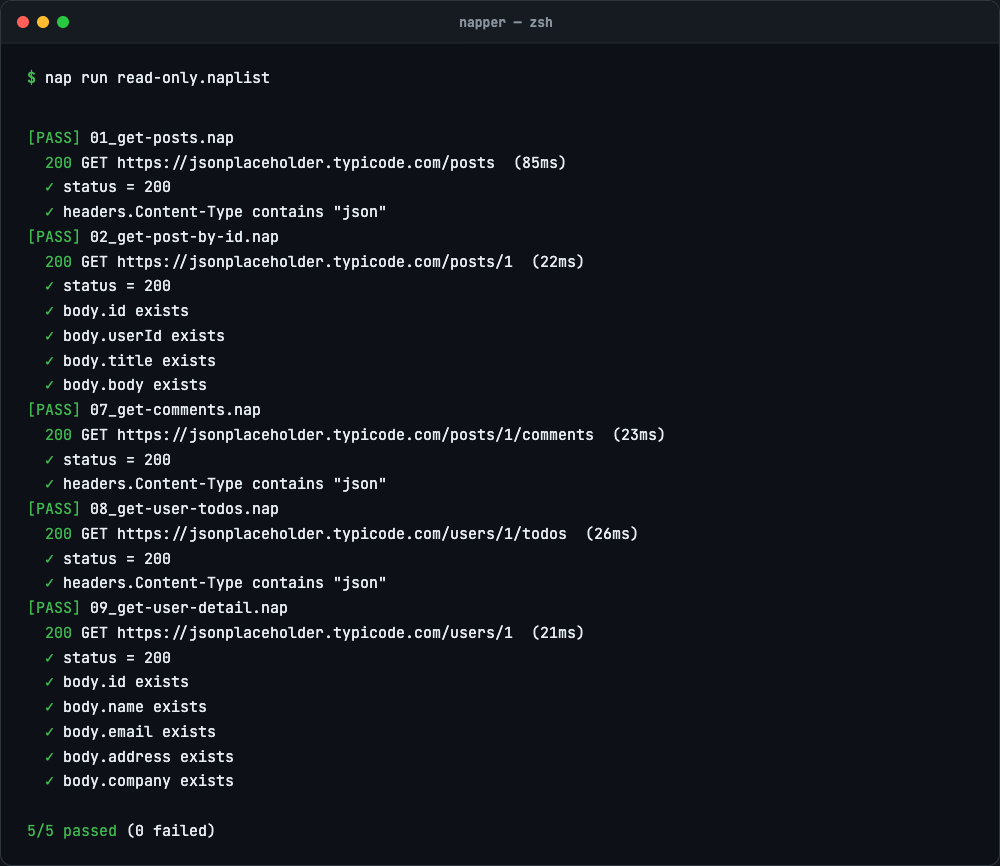
That's it. One line. Run it from the CLI:
napper run ./health.napOr from VS Code with a single click.
What happens when you need more?
Add headers, bodies, assertions, and environment variables (spec: nap-full):
[meta]
name = Create user

[request]
method = POST
url = /users

[request.headers]
Content-Type = application/json
Authorization = Bearer

[request.body]
"""
{
  "name": "Ada Lovelace",
  "email": "ada@example.com"
}
"""

[assert]
status = 201
body.id exists
duration < 500ms
Chain requests into test suites with .naplist files (spec: naplist-file). Add JavaScript, Python, F#, or C# scripts for advanced orchestration — your language, your runtime, no sandbox (spec: script-js, script-py, script-fsx, script-csx). Output JUnit XML for your CI pipeline (spec: output-junit).
Already using .http files? (spec: cli-convert)
Napper includes a built-in converter to migrate your existing .http files. Both Microsoft (VS Code REST Client) and JetBrains (IntelliJ, Rider, WebStorm) dialects are supported:
napper convert http ./requests.httpThe converter maps variables to .napenv files, preserves request names, and converts JetBrains http-client.env.json environments. See the .http file comparison for details.
Why is the CLI the primary interface?
Napper is not a GUI-first tool with a CLI bolted on. The CLI is the primary interface. The VS Code extension operates on the same files and provides the same features in your editor. This means your API tests work the same way locally and in CI/CD, with no import/export step.
Next steps
- Install Napper to get started
- Follow the Quick Start guide
- Learn about .nap file format
- Import an OpenAPI spec to generate tests automatically
- Migrate from .http files with the built-in converter